Pandemic Underlined Case For More Cooperation

The Covid pandemic revealed the need for closer and more formal links between the UK and Scottish Governments so that we are better prepared to face down emerging health threats, a report by Our Scottish Future says today. 

Based on interviews with senior figures in both the London and Edinburgh governments, the paper calls for the close working relations built up between Health Ministers during the pandemic to become a permanent feature as we prepare to combat health threats such as air pollution and bioterrorism. 

It also backs more joint working between the Westminster government and the Devolved Administrations to help reduce the huge hospital waiting lists which have been built up during the pandemic, and to support the efficient purchasing of PPE and new life-saving drugs.  

The report says the greater cooperation should be led by Number 10 and backs quarterly meetings with the Prime Minister and First Ministers of the UK. 

Writing the foreword to the report, Professor David Kerr said that while the delivery of the vaccine showed the country functioning at its best, there was also a “deficit of cooperation and coordination between the UK and Scottish Governments which only risked potential damage to our response to the disease.” 

He concludes: “The health professionals and experts we have already spoken to are clear: in the coming years, cooperation will be vital if the NHS is going to continue to meet demand, keep apace with medical advances, and do so efficiently.” 

“The NHS is our best loved and most trusted public institution. It is by working together cooperatively across the UK, that we can keep it that way and strive to provide health equity for all our citizens.” 

The report says that the pandemic represented the ultimate “stress test” for cooperation the UK and Scottish Governments. It notes that while joint working got off to a good start when the outbreak emerged last February, it collapsed in the summer when, amid a series of political rows, communications appear to have ceased entirely.

The paper says the “jury is out” on reforms to the UK state but welcomes fresh attempts to agree a plan for intergovernmental relations and the publication of new joint UK wide frameworks on public health and health security. 

In conclusion, authors Eddie Barnes and Evie Robertson write: 

“Ministers and officials from across the UK were faced with an unprecedented emergency in March 2020 and, at their best, they performed heroically in search of common solutions. This was exemplified by the way the various NHS agencies across the UK mobilised at speed to prepare for the first wave, and by the remarkable vaccine effort earlier this year, when genuine collaboration and cooperation supported a national effort to protect thousands of lives. At other moments, however, relatively minor differences in emphasis and presentation between key politicians across the UK led to a breakdown in effective engagement between the centre and the nations of the UK, potentially putting public safety at risk.” 

“Given the fact that the decisions taken by the four administrations were notable for their similarity and uniformity, this must be a cause for concern and for reflection by governments across the UK. If we are to learn the lessons of the pandemic, avoid political turf wars, and create a truly cooperative Union, then a more formalised working relationship between the UK Government and the Devolved Administrations should be mapped out with urgency. This will not just support better governance of the next health crisis to hit the UK but will also deliver better government across the United Kingdom in every area of public policy.” 

The full report can be found here. 

Our Recommendations 

1. Creation of Permanent, Formalised and Open Lines of Cooperation between Governments on Shared Health Challenges across the UK. When it comes to future pandemics, the continuing risk of Covid, of from other major health risks such as air pollution, bioterrorism and microbial resistance, we work best when we work together. We welcome the steps already being taken to formalise the ad hoc arrangements for collaboration and cooperation on health security and health emergencies and urge our Governments to work harder so that experts, Ministers and officials from across the UK are in regular and close contact on a standing basis. It should not require a once-in-a-lifetime pandemic for Ministers across the UK to form a working relationship with one another. New forums of cooperation should ensure that Governments from across the UK are able to hold strategic level discussions and develop policy in areas where they and the UK Government have a shared responsibility. This could – and should – extend to having a formalised steering committee, meeting regularly without fail, to develop joined up policy areas, and providing an arena where experts can be invited to collectively share knowledge and recommendations to not just Westminster, but regional governments as well. 

2. The new UK Health Security Agency should coordinate closely with the devolved administrations to examine how more joint working can protect the UK from health threats. Public health is devolved and should remain that way, but the experience of Covid shows that close collaboration between UK health agencies and their counterparts across the country is essential in coordinating a quick and effective response. The UK Health Security Agency should look to organisations such as the Centre for Disease Control (CDC) and FEMA – and their interaction – for best practice on joint working and mobilisation to counter threats.  

3. A United Response across all Four Nations to Deal with the Aftermath of the Pandemic. We believe that there should be a united response across all four Nations to coordinate the response to dealing with the aftermath of the pandemic in terms of the massive backlog that has built up as resources were diverted, rationally, to deal with the extraordinary challenge of COVID. We saw great examples of cooperation between ambulance services North and South of the border, utilising spare capacity for the benefit of all. The UK became a world leader in managing hospital waiting times and we recommend that clinical networks are established to work in unison to use every scrap of capacity and respective resources we have to deal with our collective backlog. We define a Network as an often geographically disparate group, united by a common aim, one might argue, the underpinning ethos of our truly National Health Service.  

4. The Prime Minister should be at the centre of these changes. The draft Intergovernmental review proposes that he chairs one annual meeting with the First Ministers of Scotland and Wales, and even suggests he could passed on to a “nominated deputy”. At a minimum, the Prime Minister should commit to quarterly meetings with the First Ministers.  

5. A review of Drug and PPE procurement processes across NHS England, Scotland, Wales and Northern Ireland in light of key learnings from the vaccine procurement plan, to consider where the UK can best leverage its ‘scale and buying power’ to bring efficiencies and value for money for taxpayers, whilst adhering to competition frameworks in place. 

Friendly Fire

UK Government Ministers can argue with some force that it is impossible to work with the SNP Government to improve the way the Union works given the Scottish Nationalists have no interest in doing so. But what about working with those calling for change who do want it to have a future? 

In the last week or so, more proposals for reform of the Union have been made by pro-Union voices. In a debate in the House of Lords, numerous peers set out the need for a better way of working (summarised by the Herald’s Michael Settle). The First Minister of Wales, Mark Drakeford, published an updated version of his 2019 plan “Reforming our Union”  on how to build a new culture of shared governance in the UK. Then the mayors of Manchester and the North of Tyne Combined Authority, Andy Burnham and Jamie Driscoll, addressed the House of Commons Public Administration and Constitutional Affairs Committee where both argued that Whitehall continues to have a “blind spot” when it comes to dealing with England’s devolved regions. 

A common theme emerges around the need for the government of the Union to re-examine how it convenes and mediates the United Kingdom. Crossbench peer Lord Kerr urged the Prime Minister Boris Johnson to “get round the table with your counterparts (in the devolved nations), settle the structures and make them work.” In its paper, the Welsh Government argued that the big issue thrown up by devolution now was about “how the UK as a whole should be governed, with proper account taken of the interests of all of its parts”. The Union was, it added “a joint project between England, Wales, Scotland and Northern Ireland, based on a recognition of our mutual inter-dependence, which therefore requires a degree of shared governance.” Meanwhile in evidence to the Commons, Burnham talked about the lack of “machinery” or “architecture” within the UK state which made it difficult for him as Mayor of Manchester to work with London. Some departments were good, he noted; others not so but there are “no formal protocols” to help guide matters. This doesn’t just apply to his working relationship with London but with other devolved governments: hence the fact that he only got to hear about Nicola Sturgeon’s strange and peremptory ban on Scots visiting Manchester when he read about it in the Guardian a few Saturdays ago. 

In summary, the focus of concern among peers and politicians who are examining the state of the nation is less about the division of powers between the centre and the devolved nations and regions, and more about the failure to organise the relationship between the many layers of government which have evolved across the Union over the last two decades. Burnham went briefly through his reading of the history. The Thatcher government in the 80s, he argued, had weakened local government across England. The Labour government in the 90s and 2000s had then decided that Whitehall targets were the way to achieve results. Both had the effect of cementing power, control and authority in London while weakening it outside of the capital. Tory and Labour governments then introduced and expanded devolution in Scotland, England and Wales and, consequently, Whitehall’s command and control culture has run up against some increasingly assertive mayors and First Ministers who argue they are the ones in charge of their own territories, and think Whitehall is there to help them deliver their own mandates and priorities, not the other way around.  People can argue the toss about which one is right but ignoring the clash isn’t going to be an option. As Burnham noted: “The genie is out of the bottle, English devolution is out of the bottle.” 

A new agreement on intergovernmental relations is expected soon which is expected to tackle some of these matters. But the devolved leaders across the UK are now discussing far more radical issues, such as a new written constitution to try and codify matters and reform of the House of Lords. The Welsh Government argues that a new second chamber should have special responsibility for ensuring that devolved institutions are taken into account in the UK parliament. Burnham agreed, making the point that the current membership of the House of Lords is currently predominantly drawn from within the M25.  

None of this is particularly headline grabbing while a pandemic is on nor while football entrances the nation. And it can fairly be argued that governments have always got something better and more urgent to do than long-term reform. But the fact remains that the genie is indeed out of the bottle and, across England, Wales and Scotland, the genie is becoming increasingly noisy. For the Government in Whitehall, this friendly fire from pro-Union figures across the UK urging change and renewal is surely worth listening to. 

The Union Is Beginning to Think Through its Future

In the words of the Scottish academic Colin Kidd, academics and thinkers have tended to view the case for the union of the United Kingdom as an ‘intellectual dead-end’. Either the arguments in favour of the UK have been taken as so self-evident that nobody has felt it necessary to set them out – what Kidd has termed “banal Unionism”. Or it has fallen back on hackneyed cliches around empires built and battles won. With the SNP having forced Scottish nationalism into the political mainstream over the last few years, so the lack of a modern intellectual scaffolding on which to build a firm pro-Union argument has been exposed.  

Is this now changing? One of the more surprising and interesting developments since May’s Holyrood election is the extent to which most of the thinking and questioning about the future of Scotland and the UK is coming largely from the pro-Union side. This brief period of relative calm in Scotland’s relentless electoral calendar is being used to challenge assumptions and scrutinise principles; to kick the pro-UK tyres.

Take some of the evidence being given to committees in the Houses of Parliament in recent weeks by some prominent former civil servants and ministers in the UK administration who have had deep and first hand experience of the last twenty years of devolution. It’s a pity that the Scottish Parliament has so far found itself unable to hold such conversations because the insights that have been offered to the House of Commons and House of Lords in recent weeks have given a more mature assessment of the UK’s constitutional position than anything that has emerged from Holyrood in the last few years. Their evidence has focussed on the general question of how the UK Government faces the Union question and how it manages the newly devolved nation state.  There is too much to distil down into one short article, but some key issues are worth flagging up.

What do we actually mean by the union?

The House of Lords constitution committee is currently looking at the future governance of the UK. Last week it took evidence from two senior figures with immense governing experience, Philip Rycroft, the ex-Permanent Secretary at the Department for Exiting the European Union (and a current director of this think tank), and Ciaran Martin, a former chief executive of the National Cyber Security Service (both were also recently interviewed by Reform Scotland).

Martin raised what is a first principles issue. 

“There is an important question for British politicians in power and seeking power at a UK-wide level to think about what sort of union they are trying to preserve? There are two models – a multinational, diverse, multigovermental UK. Or a more assertively singular British states model of unionism.”

The latter, he noted, was a form of “Anglocentric British nationalism”. Both visions of the Union were valid, Martin noted, but in practice they are mutually incompatible. The problem is that, having created the former Union by introducing devolution, the British State largely carried on as if it hadn’t happened. Martin recalled the mood in the civil service in the late 90s after devolution was introduced. The country had just come out of recession, had tamed inflation and had got the public finances back under control. The view from Whitehall about devolution, Martin recalled, was “Whose crazy idea was this and how can we limit the damage?”

“If you contrast the pageantry of the official opening of the Scottish Parliament in 1999 with Her Majesty the Queen and Donald Dewar and all of that, with the obsession—and I would call it that—with just making sure that these new bodies were under control, the failure to engage with that debate about the emotional re-engineering of the union will not be looked favourably on, I think.”

Together with that institutional resistance, there developed a culture of what has become known as “devolve and forget”. Government departments weren’t incentivised to think creatively about the Union or to consider how sharing power or working with the devolved administrations might work.

Rycroft noted:

“The result of all of that was that devolution tended to be pushed to the periphery of departmental understanding, departmental management and departmental attention; that was both political and official. We made some progress over those seven years but, frankly, with the demands of Brexit and then of Covid, of course this has had to take bit of a back seat.”

Of course Brexit changed the entire dynamic and brought to the surface the conflict between the two definitions of the Union – with the more traditional version winning hands down. It has now left a question hanging in the air, as Rycroft put it.

“Do you seek to go down a road of collaboration and co-operation (with the devolved nations and regions) or do the UK Government seek to impose their view, whatever the thoughts of the devolved Governments?”

It is both easier for Whitehall and more politically palatable for the current UK Government to do the latter. Efforts to reform the Union are undermined, concluded Rycroft, by “the weakness of understanding in depth in Whitehall but I would say also in Westminster about devolution and the politics of the devolved parts of the UK, compounded in recent years by an unwillingness, a political failure, to accept the legitimacy of the voices of the other parts of the UK and to give them due accord in the important debates on the issues of the day.”

Martin quoted Robert Saunders of Queen Mary University.

“(He) said that the problem at the moment is that there is a risk that the Government’s approach to the union, their love for the union, if you like, is like the love for a possession, something one owns, rather than the love for a partner.”

Love for a partner, he added, requires you to “choose to act differently for the sake of the partnership”. 

What's needed is statecraft, not just structures

These parliamentary sessions come as Whitehall prepares to unveil a new agreement on intergovernmental relations with the devolved administrations. A 15-page draft has already been drawn up, codifying how the UK Government and the devolved administrations will relate to one another. The hope is that it will be signed off in the next few weeks. Everyone agrees this is clearly necessary and welcome but to assume that a guidebook on setting out the rules of engagement will provide the underpinning for the Union is a superficial reading of events. It is not just the lack of a document, but the lack of imagination that has led to the current impasse.

Rycroft told the Lords:

“When the history of this period, and I am talking about the last quarter of a century, is written and all of us around at the time have some responsibility for this, I think the sheer technocracy with which we responded to devolution will be seen as a weakness, a failure to grasp the extent of the cultural, emotional and national identity changes, particularly in Scotland.”

Martin concurred: 

“Something we might come on to—and I share responsibility for this—is the UK state’s approach to devolution since its inception a quarter of a century ago, which has been excessively technocratic and not thinking about the vision of the sort of United Kingdom we want to have.”

Questioning the pair, Lord Hennessy set out the matter too.

“I have always felt that funding formally, devo maxing, refreshing of structures and so on are absolutely critical too, but above all it is what General de Gaulle was alluding to in the first line of his memoirs when he wrote, “I always had a certain idea of France” and unless you have a certain idea of the union, really it is all lost.

What has been missing, said Martin, is a “thoughtfulness on the Union”.  Contrast the UK Government’s approach to the Union to the way, for example, the peace process was agreed in Northern Ireland by Conservative and Labour administrations in the mid-90s. 

Martin noted:

If you compare, for example, the statecraft that went into many, many years in extraordinarily difficult circumstances—over both Conservative and Labour Administrations—that led to the settlement in Northern Ireland in 1998, and you look at many of the papers that have been declassified, and you look at the profound thinking given to things like the statements in the Downing Street Declaration and the initial statement authorised by Mrs Thatcher about no selfish or strategic interests in Northern Ireland, that cut-through, that strategic emotionally sharp political statement followed through into action in terms of the agreement with the Irish Government in December 1993, it is hard to see that sort of strategic thinking incentivised in the Whitehall that I left.”

It is the lack of statecraft that “is most deficient” within government when it comes to the Union, he concluded.

It was a theme that was taken up in an earlier meeting of the House of Commons Public Administration and Constitutional Affairs Committee by Andrew Dunlop, the Conservative peer who was the key advisor to David Cameron during the Independence Referendum. More recently, Dunlop has published a Review of Intergovernmental relations examining the relationship between the centre and the devolved nations. His main purpose, as he told the Committee, was to bring about the same culture change at the centre of power. 

“My main approach to intergovernmental relations is to change them from a very defensive activity where everybody puts on their hard hat, grins and bears it and tries to get through, minimising the chance of fallout. I want the whole atmosphere around intergovernmental relations to change, to make a much more proactive agenda that looks at where there are issues of common interest—and there are many—where the powers of the UK Government and the devolved Governments intersect, and it makes sense to work together, whether it comes to the productivity challenge, how to address climate change or tackling drug abuse. Those are all areas that would benefit from a common approach and working together.

“We can talk about structures, but my whole approach is that at the heart of this is how you change culture. There is no magic silver bullet for changing the culture in an organisation; it requires a whole series of things. My report was a series of interlocking measures to create the right package of incentives to change that culture. If you are to achieve that culture change, you need to look at it and take it forward as a package.”

So, what should be done?

There may be no magic bullets, but what are the ways to bring about this culture change? 

Dunlop’s Review set out a series of recommendations – a new UK Intergovernmental Council to improve relations between the various UK Governments; a joint fund to promote UK wide projects and collaborative working; a new great office of state, a First Secretary of State for Intergovernmental affairs; and reform of the civil service so promotion is dependent on knowledge of devolution. Some are being adopted by the UK Government, others – such as a new Cabinet Minister – are not.

In their evidence, Rycroft and Martin threw up some more reforms. The new package of measures on intergovernmental relations introduced by the UK Government might be put on a statutory footing, argued Rycroft. And there is the wider question of whether “muddling through” has run its course and the UK finally needs to write down its constitutional foundations.

Rycroft noted:

“There is a question as to whether the UK would ever be prepared to move into the space of a formal written constitution in the way that pretty much every other democracy in the world, as we know—bar New Zealand and Israel, to memory—has. We have never had that sort of foundational moment where that has been required. You could argue that muddling through—going back to the 1832 Reform Act and all major subsequent reforms since then—has sort of worked for the UK. I do wonder, however, whether we have reached the moment—with all the things we have been discussing today and also with the way in which the conventions that have hitherto propped up our constitutional arrangements have frayed or been seen to fray—to step back and to say, if not a full-blown written constitution, “There is more of this stuff that needs to be written down”.

He also raised the consent – what should happen when, in a devolved or an area of shared responsibility, a devolved government refuses to back a proposed reform (the obvious example being the implementation of Brexit)? Rycroft asked:

“Should there be a requirement, for example, if the UK Government wish to act in the teeth of opposition from the devolved Governments, for a second look, for a delay? 

“Short of an absolute veto on the part of any one Government, as in the Carwyn Jones proposal from the Welsh Government, should the UK Government need at least one other devolved Government on side to take a proposal through?

And, then, there is the question of England. Rycroft floated the idea of a Minister for England. 

“I think there is an argument to say about departments where self-evidently 99% of their business is English business, why not make those explicitly English departments? People may say, “Won’t that detract from the union as a whole?” I think clarifying where power lies and where responsibility lies will help people to understand the nature of the union as we have it now, post devolution. Whether there is a place for England in the structures of intergovernmental relations has been mentioned already. At the moment the UK Government wear both the UK hat and the English hat. That militates against coming to conclusions in that context where the UK Government can be seen to be operating for the whole of the UK.”

The value of deeper thinking

These are – as already discussed – largely technocratic answers to the debate around the future of the United Kingdom. But they are far from irrelevant. These dry debates about the nature of intergovernmental relations, joint ministerial committees, and dispute resolution mechanisms are better seen as the bureaucratic tip of the deep social and cultural questions that face this complex messy nation, and our own interest in its continued good health. Questions like – is this a nation which is prepared to expend energy, time and thinking power on the question of its continued existence? Or questions like – faced with the possibility of divorce, is this a country that wants to work at keeping together? For many the best answer – as with the West Lothian question – is not to ask such questions: after all, the Union works just about; don’t make the perfect the enemy of the good; be careful about opening a pandora’s box. But – post devolution, Brexit and Covid – this model of muddling-through-Unionism is being stretched to breaking point. And here is the rub. The case for Scottish independence isn’t rooted in the supposed practical benefits of secession – after more than a decade in office, neither Alex Salmond nor Nicola Sturgeon has found a convincing sales pitch which convinces a majority of Scots. Rather the case for independence is growing from a sense, repeated incessantly by the Nationalists, that the country is inevitably drifting apart and that there’s nobody, least of all Whitehall and Westminster, who is really given much thought to stopping it. It’s a model which sees independence happening by way of indifference.  

This is why the thinking on the Union emerging just now is so welcome and necessary. It is having an impact in the corridors of power. It also shows that, far from being an intellectual dead-ed, there are people across the UK engaged and focussed on the fundamental questions: why bother with a Union? What is it for? How can we make it better? Most of the intellectual heavy-lifting in the debate around the future of the UK is currently coming from those who would like it to have one. This is a cause for optimism. 

“Scotland in a Zoom” Project Published

Our Scottish Future has today published the findings of a ground-breaking new project that brought together scores of Yes and No voters from across Scotland.

“Scotland in a Zoom” encouraged voters on both sides of the constitutional debate to actively listen and positively engage with each other, before seeing where they could find consensus on a path forward for the country.

More than 80 voters from across Scotland took part in the virtual project in February and March this year, in groups of twelve over Zoom.

While participants disagreed on the big question of independence, the conversation events revealed widespread agreement across the constitutional divide.

As part of the session, Yes and No voters were grouped together to set out their priorities over the coming years. The sessions found: 

  • The vast majority of Yes and No supporters agreed investment in the economy, NHS and education were the top priorities for Scotland.
  • Investment in the NHS as it recovers from the COVID-19 pandemic was the top priority overall, agreed by two thirds of the groups.
  • Tackling climate change was also frequently cited, with a third of groups agreeing it should be a priority. 

In the events, equal numbers of Yes and No voters were placed into groups and asked to seek agreement on a constitutional path for Scotland.  

Though a majority did not want a second referendum under the timescale set by the SNP Government, there was widespread agreement that the constitution needed to be discussed over the coming 5 years, and that more opportunities to engage with each other would be beneficial. 

Our Scottish Future has set out a series of recommendations on the back of the report.

We are calling for politicians on all sides to find ways to allow the public to keep talking about the constitution – through Citizens Assemblies.

But key issues such as fixing the NHS, tackling climate change, giving young people hope for the future, and providing better quality housing cannot be put on hold, given people’s shared belief in action now.

It follows the call by former Prime Minister Gordon Brown last week for both the UK and Scottish Governments to do more to cooperate with one another on the key challenges Scotland faces, and on the constitution. 

Our Scottish Future project manager Eddie Barnes said: “Despite the apparent 50-50 division in political debate in Scotland, the project showed that voters from either side of the constitutional divide share many of the same values and hopes for the future – and, crucially, want those values and hopes to be better reflected in our politics.” 

“Participants appreciated the chance to hold a respectful conversation with people they disagree with on independence and the union. We believe the lesson for political leaders is to find more ways to bring people together to talk and listen to one another about these key issues.”

Scotland in a Zoom co-author Andrew Liddle said: “This report found a clear consensus among both Yes and No voters that Scotland must seek to avoid repeating the mistakes of Brexit when addressing its own constitutional future.”

“That means politicians better engaging with voters, but also being patient and not rushing into decisions that risk unnecessarily dividing Scotland.”

A copy of the full report can be found here.

It was compiled by Andrew Liddle, Eddie Barnes, Henry Stannard and Laurence Shorter.

Please see case studies of two participants who took part in the event. 

NO – Chelsea Rocks, 24, from West Dunbartonshire

I am not one of those people who goes around saying how much they love Britain. I just don’t think there is enough evidence that Scotland would be better off independent, and my view is – why would we do something that leaves us worse off? That said, I don’t blame Yes supporters for wanting change – especially when you see the deprivation and inequality around us. If you’ve only got £10 left, then you might well feel it’s worth the gamble – what have you got to lose?

The event provided us with a forum to talk. To begin with, some of the Yes people in the room had quite a lot of misconceptions about the No voters – I think they saw us as Unionist flag wavers. But once we battled past that, we were able to have a back-and-forth conversation and it turned out that there was a lot of agreement. When it comes to the economy, to the heath service, to education, the truth is that we all want the same things,  we just disagree about how we get there.

The format of the event really helped. Even when you’re talking to family members or you’re in the pub, if the subject of the constitution comes up, it can just descend into – well you’re wrong, and I’m right. Spending time looking at what we agree on opens you up to the idea that you might both be right and that leads to a much more mature conversation. It was also an opportunity to us to find out why people think independence is a good idea. You don’t get that in social media or in Holyrood or Westminster where all you get is politicians going back and forth at one another. We need more spend more time focussing on the things we agree on and then look at how we go from there.

YES – Gary Reilly, 38, from Edinburgh

For me, it comes down fundamentally to how we take the country forward. What we’re being offered by Westminster is a politics that’s sliding further to the right at every election. I would argue that this isn’t what Scotland actually votes for, it’s also not what Unionists in Scotland support either.

I thought the 2014 vote would have been enough of a scare for Westminster for them to equip the Scottish Parliament with genuine power but instead we got a bit of tax and tinkering with social security. I just don’t think Westminster is able to offer the kind of change people in Scotland want. 

Scottish politics can be a bit of an echo chamber so it was really nice to have a forum where you could speak to people of a different point of view. There’s also a lot of common ground – when somebody is talking about the NHS and the importance of healthcare, you don’t know whether they are Yes or No. I was paired with a lady who had real concerns about the impact of independence on the economy; she had a valid point. I don’t think it will be easy and there will be tough decisions to take.

One of the things I come away with as someone with a Yes perspective is that you have to stick to the basics. People want to know how they are going to pay for their weekly shopping, for their kids’ schooling and for their families. The basics really matter. Things like the currency arrangement – we need to have a common-sense position that people can understand.

On the referendum, a lot of the concern people had was on the timing of it. We should wait until we are through the worst of Covid. I do feel that we won’t be equipped fully for that until we are independent and have the full scope of powers that independence would bring.

Tactical Voting and the Scottish Green Party

Last week, we released the results of our ‘Morning After Poll’, detailing our view of what Scotland voted for and why.  We tried pretty hard to be neutral in our tone, and give each party and side of the constitutional debate a bit of food for thought before making any big claims about what people voted for.

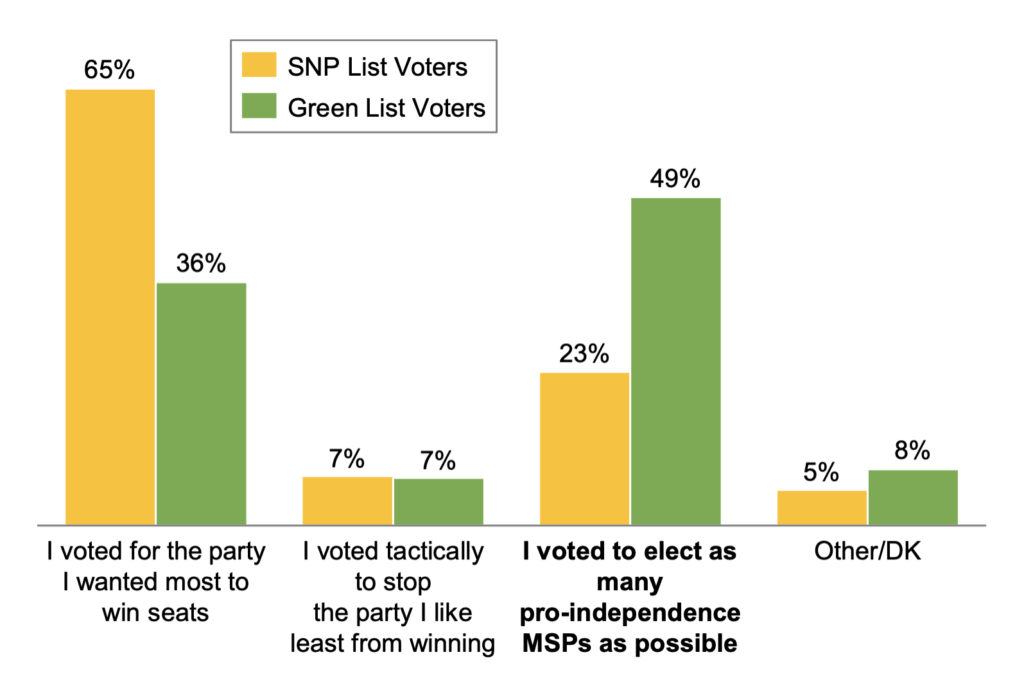
One interesting fact that caught us when we looked through the detailed poll findings was that after all of the pre-election conversation of Alex Salmond’s gambit for SNP List votes, the party that had the most benefitted from SNP switching was the Scottish Greens, who won over 6x the number of SNP constituency votes on the list as the Alba party, with half of their voters saying ‘I voted to elect as many pro-Independence MSPs as possible’ (not ‘I voted for the party I most wanted to win seats’)

Whilst interesting, this was not particularly surprising. We have no particular knowledge of SNP or Green campaign strategy, but it seemed fairly clear during the debates that Nicola Sturgeon and Patrick Harvie were enjoying at least some sort of unspoken mutual non-aggression pact that led to the near-absurd end-point of Nicola Sturgeon’s kindergarten teacher-style ‘interrogation’ of Patrick Harvie  in the STV debate (‘so what you’re saying Patrick is that there is no way to build the Scotland you want without Independence?).  

Indeed, perhaps the most surprised person in Scotland about these findings is Patrick Harvie, whose intemperate pool quote on the issue ended ‘it makes no sense at all to highlight some SNP voters who aren’t convinced about independence, but then pretend without a shred of evidence that every Green voter is voting tactically on the constitution alone’. Leaving aside the logical and evidential flaw in his argument (it’s half of his vote, not all of them),  we thought it worth showing some more shreds of evidence beyond the report we published, in case he is interested in learning about why people vote for his party in Scotland.

Before we go into detail we should be clear – with only 80 Green voters in our poll (c.50 on a weighted basis), some of the cross-cuts we refer to here are low n, but hopefully show enough evidence volume of evidence for those declaiming the political purity of their vote to at least countenance that the Greens benefitted from some SNP/Pro-Indy voters lending them a hand up the D’Hondt ladder.

The Background: The Greens are a party with very little ‘core’ support

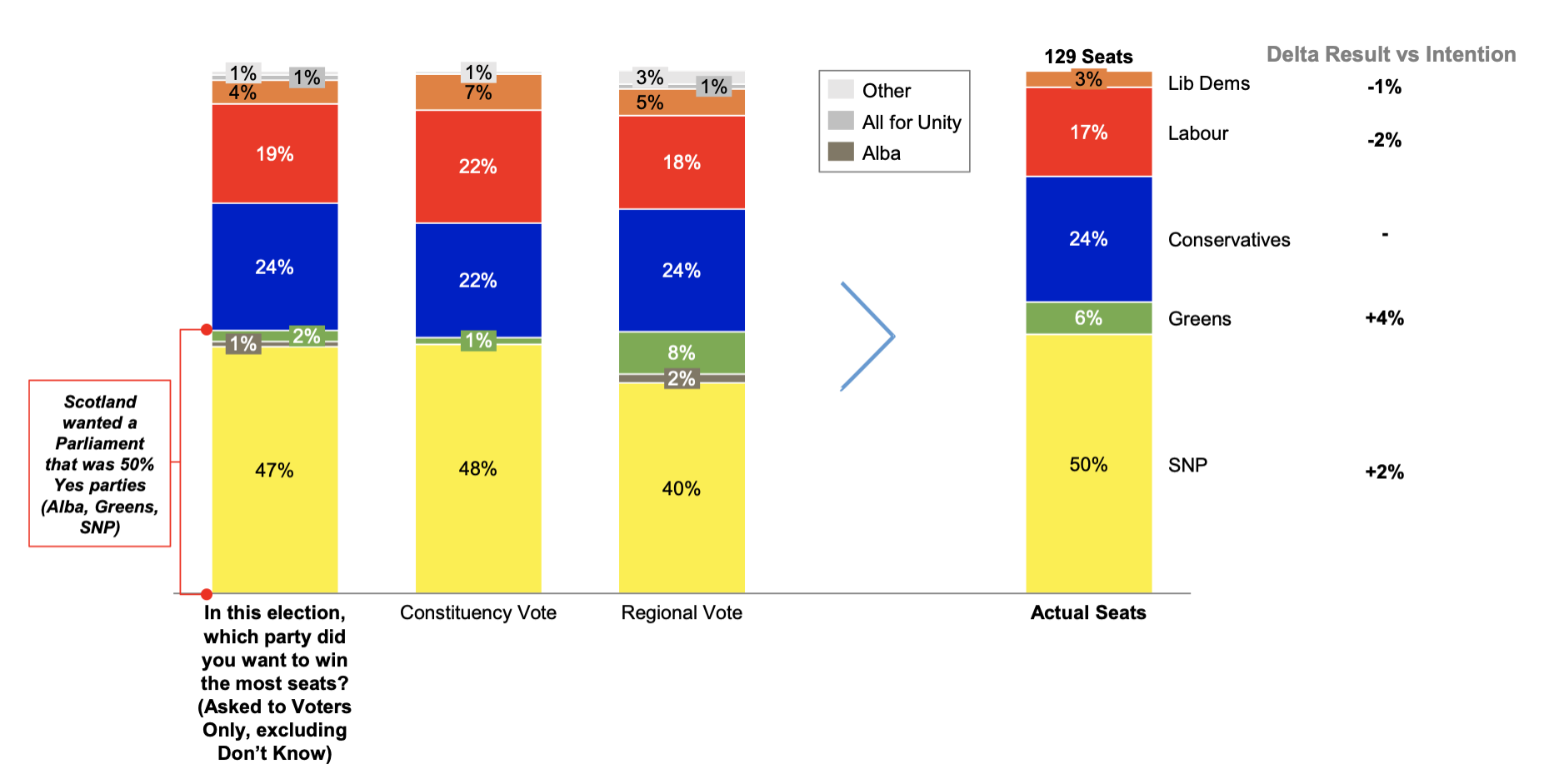
As was published in our report on Thursday, we asked voters the day after the election the question ‘In this election which party did you want to win the most seats’.  We thought this would be the best way of working out what the ‘true desire’ of Scottish voters was, excluding tactical voting or use of the list as a ‘second preference.  The results aligned fairly well against the actual regional vote share of all the parties, other than the Greens.

The implication of this is fairly clear – whilst the Greens clearly have a good brand and people who like them there are very few people in Scotland who wake up in the morning defining themselves as a ‘Scottish Green’ politically. 

The Evidence for Tactical Voting

In our analysis we stated that around 50% of the Scottish Greens’ vote was tactical in order to maximize Yes MSPs.  This was a result of the response to the question Which of the following was most important in your voting decision at this election for your peach regional list vote?, where around half indicated that they just wanted to elect as many Pro-Indy MSPs as possible (a number that grows for SNP to Green switchers) 

Uncovering the true intentions behind people’s voting patterns is notoriously difficult to do, not least because of how people post-rationalise their behaviour.  However, we have a number of triangulating points that imply that a substantial proportion of the Green vote on the list was from SNP supporters who are strongly in favour of Independence 

  • 73% of Scottish Green list votes came from voters who voted for the SNP with their first vote (and 10% from Labour voters), making them the only one of the five largest parties to rely predominantly on one other party’s votes for a majority of their regional vote
  • 68% of the Scottish Green regional vote wanted the SNP to win the most seats – again this is highly unusual vs all other parties.  90% of SNP regional voters wanted the SNP to win the most seats, a number that is 77% for Labour, 85% for the Tories
  • The Scottish Green regional vote was substantially more nationalist than their constituency vote – with 65% of their list voters being either 9 or 10/10 in favour of independence (slightly more than SNP voters…) vs 46% of their constituency voters.
  • Scottish Green list voters prioritise having a second referendum more than SNP list voters (with 31% having preparing for a 2nd referendum as a top 3 priority for the Scottish government vs 26% of SNP voters)
  • Although a low n so to be taken with a pinch of salt, we also see a huge amount of switching from voters who voted Greens in the constituency to the SNP on the list (c.78% of Green voters)

The Implications of Tactical Voting

With the assumption that c.50% of Scottish Green votes were tactical votes lent by SNP voters, a Scottish Green vote of 4% (vs the 8%) and an SNP vote of 44% (vs 40%) would have had the following implications for the Scottish Greens at a regional list level, losing 6 of their 8 seats, giving 2 seats (and a majority) to the SNP, 3 seats to Labour and a seat to the Tories

  • Losing their final list seat in Central Scotland to Labour
  • Retaining their seat in Glasgow (slipping from 4th to 7th)
  • Losing one of their two Lothian seats to the SNP
  • Losing their Highlands & Islands Seat to the Labour party
  • Losing their Mid Scotland & Fife Seat to the Labour party
  • Losing their North East Scotland Seat to the Tories
  • Losing their West of Scotland seat to the SNP

For the leadership team of Patrick Harvie and Lorna Slater, there is a happy coincidence between their position on independence and their own self-interest as politicians seeking election. The Green cake was baked with pro-independence ingredients – and the party cannot protest when people wish to point out that they are eating it. The question it leaves hanging is who in Scotland is best able to represent environmentalists who do not view Scotland’s constitutional question as among the most pressing issues around climate change.

Full data tables for our ‘Morning After Poll’ are available at: https://www.stackdatastrategy.com/data

Our Scottish Future’s “Morning After Poll” Reveals “Middle” Scotland

Our Scottish Future is today releasing the full findings of our exclusive “morning after poll” taken as Scotland voted in the election ten days ago.

The poll asked 1,000 Scots to set out why they voted as they did, what views they held on independence and another referendum, and what they want from the Scottish and UK Governments over the coming 5 years.

Key findings include:

  • A half of “Middle Scotland”, the voters who are open-minded about independence and the Union, backed the SNP – but they did so because they felt the party provided the best vision and leadership, not to get a referendum
  • In total, only 54% of SNP voters agreed we should start preparing for a referendum immediately, and one in five were either against independence or unsure.
  • Tactical voting for the Greens on the list by pro-independence supporters may have deprived the SNP of an overall majority. Had SNP constituency voters instead stuck with the SNP on the list, Nicola Sturgeon could have gained three more list seats.
  • Scotland is divided 50-50 on whether to have a referendum in this parliament, and support among many is conditional on whether the economy has recovered, and whether the options on both sides are clear.
  • Voters do not want the SNP to be “referee and captain” of the process, and they want the SNP to provide more facts about independence.
  • A majority of Scots think the best way for the pro-Union side to make its case is through cooperation, not confrontation with the Scottish Government.

The poll was carried out by Stack Data Strategy. 1,000 Scots were polled between the 7th and 8th of May 2021. Responses were weighted to census figures on age, gender, education level, and recorded 2021 vote in the Scottish Parliamentary elections’

Analysis of the poll is available here.

Writing in its introduction, authors Henry Stannard and Evie Robertson conclude:  

“There a third ‘Middle’ Scotland that neither conforms to a binary Pro-Union or Pro-Independence view of the world, but that is greater in size than either of the extremes in the constitutional debate. Citizens in this Middle Scotland are both primarily Scottish and meaningfully British.  They vote in their droves for the SNP not because they want a referendum, but because the SNP appear to offer good leadership and government within a devolved state.  They do not oppose a referendum in principle, but have deep concerns over its practicality that must be resolved.”

“We hope that politicians from both sides can start listening to them.”

Next week, Our Scottish Future will publish the results of a major consultation exercise carried out this winter and spring with Yes and No voters.

Entitled “Scotland in a Zoom”, it brought together Scots with different views on the constitution and sought to find out what they had in common and how they might agree on the next steps for Scotland and the constitution.

Our Scottish Future is a new campaign set up to advance the patriotic, progressive and positive case for Scotland as part of our wider family of UK nations. The campaign intends to speak up for “middle Scotland” – people who voted Yes, No, Leave and Remain – and who are now looking for something better than a binary choice between hardline nationalism and no-change Unionism.

Full data tables are available at: https://www.stackdatastrategy.com/data

Scotland Does Not Have The Facts on Independence, Poll Reveals

SNP Must “Open the Books”, Says Brown

A clear majority of Scots do not believe the SNP has given them enough facts about independence in order to make a fully informed choice on whether to leave the Union, a new poll by Our Scottish Future reveals today.  

Nearly 60% said they did not have enough information at their disposal on independence, the poll shows. 

And when asked about the key issues that will be affected by Scotland’s departure from the United Kingdom such as the English border, Scotland’s security arrangements, tax, currency, EU membership, and UK negotiations, fewer than a third of Scots say they feel confident about knowing what would likely happen.  

Today, former Prime Minister Gordon Brown declares that the SNP must “open the books” and warns that the SNP Government cannot be both judge and jury when setting out the case for an independent nation.  

Instead, he argues that the SNP should be prepared to open its case up to public scrutiny through parliamentary hearings.  

Today’s poll – taken over the same weekend that people voted on May 6th – also assessed people’s priorities in the wake of the election.  

Delivering a second referendum on independence was ranked 5th for SNP voters – below NHS catch up, reducing COVID, protecting and generating jobs and eliminating poverty.  

Among “middle Scotland” – the 40% of voters identified by Our Scottish Future who are open minded on the question of independence and the Union – preparing for a second referendum was bottom on the list of priorities.  

On the facts of independence, the poll asked people: “Do you believe that campaigners for independence have given enough information about what Scotland would be like if it became independent (eg: on currency, taxation, legal rights, EU membership, the border) for you to make a fully informed choice at a future referendum?  

A total of 58% said No. Only 30% said Yes. The remaining 12% said they did not know. Among those strongly in favour of independence, 66% said they had enough facts, but 24% said they did not. But of “middle Scotland” voters, 60% said they did not feel they had enough information.  

Mr Brown says today that the SNP should commit to public hearings in both the Westminster and Holyrood parliaments, so that MSPs and MPs are able to call experts on currency, finance, borders, and the EU, to get the facts on the table.  

“Middle Scotland’s support for the SNP and for independence is conditional – and they are now asking the SNP for honesty, for openness and for getting the facts on the table. It is time for the SNP to open the books.”  

“When even a quarter of committed independence supporters agree we don’t know enough to make an informed choice on independence, surely the onus is on the SNP to come clean?”  

“I believe that it is time for the SNP to agree to hold public hearings on what independence means for everything from the pound to the pension.”  

“Whether they are Yes, No, or undecided, people deserve to know the truth – from maintaining the Union, to reforming and renewing it, to leaving it altogether.”  

The poll also asked voters to set out their top three priorities going forward. “NHS catch up” was the most popular, followed by “reduce COVID/vaccines”, “protect and generate jobs”, “education catch up” and “reopen economy”. 

“Prepare for a second independence referendum” was 8th on the list. Among middle Scotland, it was bottom, and even among SNP voters, it came in fifth.  

1,000 Scots were polled by Stack Data Strategy between the 7th and 8th of May 2021. Responses were weighted to census figures on age, gender, education level, and recorded 2021 vote in the Scottish Parliamentary elections .

Scots Back Cooperation Not Conflict

An in-depth poll conducted by Our Scottish Future over the election weekend has revealed that Scots back more cooperation between the UK and Scottish Governments – and do not want them to prioritize preparations for another referendum. 

The poll – conducted as 48% of Scots voted SNP – found that a far higher number – 73 % – wanted better cooperation between Scotland and the rest of the UK. 

Given 11 key priorities for action, such as the vaccination programme, NHS spending, and an education plan for young people, Scots ranked “preparing for a second referendum” in 8th place. 

The most popular choice was “ensuring that NHS Scotland catches up with appointments and procedures that they were unable to do during COVID.” 

The poll also showed that two-thirds of Scots agree that the best way to make the case for the Union is “to encourage better cooperation with Scottish institutions and be more inclusive of Scottish views.” 

Trying to show how the UK Government was better than the Scottish Government was backed by fewer than a half, by contrast. 

The findings come as former Prime Minister Gordon Brown today announces he is to lead a fresh campaign over the coming months to promote a “patriotic, progressive and principled case for Scotland’s future within the United Kingdom.” 

New ‘Cooperation Commissions’ on health, the economy, child poverty, and the environment will be set up to examine how best the Union can provide ‘added value’ to the key challenges the country faces over the coming years. 

Mr Brown also set out a fresh call for the UK Government to establish a Commission of Inquiry into the Union to examine the reforms needed to the UK to provide a better alternative to both the status quo and independence. 

Mr Brown says today that Our Scottish Future will become a new campaign with the aim of putting “the patriotic, progressive and principled case for Scotland’s future within the UK.” 

Writing in today’s Scotsman he says: “Today our think tank Scottish Future will transform itself into a campaigning movement and invite people to join us in putting the positive, progressive, and patriotic case for Scotland in Britain. Instead of focusing on powers the Parliament does not have we will focus on how we use the powers the Parliament does have to tackle poverty, unemployment, health inequalities, and climate change. Our Commissions on the economy, healthcare, climate change, and poverty will look at how cooperation can work to Scotland’s benefit by using all the resources of the UK.  And we will argue for a reformed UK with a more inclusive centre, a forum that brings the leaders of the nations and regions together and for them to be local focal points of economic initiative.” 

He adds: “And if the Prime Minister really is to be “minister for the union” rather than ‘minister for Unionists’ then he needs to do more than call a meeting with the leaders of Wales and Scotland. He can do so by making two big policy changes. He should order a constitutional review – Sir Keir Starmer has already done – of the whole future of the United Kingdom, specifically asking it to investigate alternatives to nationalism and the status quo. And he should concentrate on furthering cooperation in those areas where all the resources of the UK can be mobilized in support of the NHS, the fight for jobs, and the war on poverty and on climate change. He must now realise he has to change if the United Kingdom is to stay in being.”

Polling questions as follows:  

To what extent do you agree with the following statements on the relationship between the UK and Scottish Governments? 

The Scottish and UK Governments cooperate well today: Disagree 54%. Agree 23% 

I want the UK and Scottish Governments to cooperate better in areas that affect my life: Disagree 7%. Agree 73% 

A more productive and collaborative relationship between the Scottish and UK Governments would be good for Scotland: Disagree 9%. Agree 68% 

There needs to be greater alignment of policy and messaging on key issues such as COVID between the two governments: Disagree 11%. Agree 66% 

The best way for the UK Government to make a case for the Union would be to encourage better cooperation with Scottish institutions and be more inclusive of Scottish views: Disagree 11%. Agree 64% 

The best way for the UK Government to make a case for the Union would be to demonstrate how it is better than the Scottish Government: Disagree 26%. Agree 46% 

The poll also reveals overwhelming support for more cooperation between the UK and Scottish Governments on the economic recovery, the NHS, climate change, the drugs crisis, education, poverty, transport, and crime. Full details can be found here.

Gordon Brown: “Time to Open The Books on Options For Scotland”

Scots want the facts. The status quo, a reformed UK, and independence should all be exposed to expert, parliamentary, and public scrutiny

Speak to Scots these days about the big constitutional questions facing our country, and there is one big thing all of us do agree on: we don’t have the facts. 

Whether people are No, Yes, or Undecided on independence and the Union, almost everybody says they need more information. They are burnt by the experience of the 2014 referendum and the Brexit vote. Wild promises on the side of a bus, false claims on lurid posters and fake news on the internet have made them more sceptical than ever.  

With our economics of our world now so different from pre-Covid certainties, that demand for facts and evidence is now more pressing than ever. It would be a travesty of democracy if the most important question – the very existence of the United Kingdom – is to be subject to such minimal scrutiny before any irreversible decision is made. 

Yet despite everything we have gone through over the last few years, and despite entire forests having been levelled to report on the complex politics of Scotland, scrutiny of the economic and social consequences of the constitutional options we have on offer is scant.

When it comes to the costs or benefits of independence, the detail is missing entirely. Instead, there is a huge information gap. In the exact same way that the Vote Leave campaign deliberately decided not to set out any detail on the reality of post-Brexit Britain, so there is now an eerie nationalist silence on what independence really means. Key questions lie unanswered: what is the plan for our currency if and when we dump the UK pound?  Given our deficit is now the largest in Europe, far higher than set out in the SNP’s now out- of- date Wilson report, how can they deliver on their promises on pension health and welfare ? What happens to our border with England and to our trade? The SNP says leaving the EU, which accounts for 15% of our exports, was a disaster: if that is the case, what is the loss of jobs if we leave the UK which accounts for nearly 60 per cent ?  

But it isn’t just the nationalists: we also need deep dive scrutiny of the status quo too and into what Boris Johnson’s’ so- called ‘muscular unionism’means for a post-Brexit, post-Covid Scotland. This should include the implications  of his Internal Market  Bill, his Shared Prosperity Fund  and his view that devolution is  a ‘disaster’.

We also need to examine the merits of change within the UK that is now the subject of investigation by a Labour Party Commission on the Constitution and which I am happy to see put to the test.

In the post Covid world we must expose all these options to the sunlight of scrutiny, and I suggest three key platforms for doing so. 

We need a trial of the evidence with independent think tanks, research organisations and academic institutions encouraged to assess the claims made by all parties and subject them to close examination.  

This is not just a demand to ‘open the books’: it is a call to subject all the arguments and claims about the future government of Scotland to an open process of investigation.

Secondly, and crucially, I believe we should also agree a trial by parliamentary scrutiny. We should ask our parliamentary democracy to step up to its task of ensuring proper transparency and accountability , and to hold to account those who govern us. All the options open to us -independence, the status quo and reform within the UK-  should be subject to parliamentary hearings, looking at all the evidence.  

The Scottish Parliament and the two Houses of Parliament in the UK- the House of Commons and the House of Lords- should each set up investigative committees made up of senior MSPs and MPs from all sides. These select committees should call and interrogate witnesses on the impact of all options on the currency, economics, the EU, pensions, welfare,  climate change and defence and security and then report on  their analysis of the facts.

Parliamentary hearings can pave the way for the third test: an open examination by the public – with new Citizens Assemblies convened and given the chance to test, stretch and dissect the evidence in front of them. Here we can learn lessons not only from the recent experience of a Citizens Assemblies in Scotland but from Ireland where a Citizens Assembly helped the country negotiate potentially its most divisive debates ever -on legalising abortion- without the bitterness many predicted.  A representative group of 100 – half initially pro-abortion, half against – came together and talked the issues through, exploring differences, asking questions of experts and interacting with each other on their fears and hopes. Remarkably, but encouragingly, people of devout faith and resolute feminists found common ground. I’d support a series of such assemblies right around the country, and if we can free ourselves from the rancor of past debates, a similar outcome might be possible in Scotland. 

Quite simply, Scots deserve the facts, not fiction scrawled on a bus, or slogans that twist the facts.

And in that spirit, I am happy for any ideas I have to be put to the test, and interrogated, challenged, and subjected to the grilling of politicians and the public. Let us now see if both no-change Conservatives and no-compromise Nationalists are as happy to see their own proposals scrutinised in the same detail and put to the sword.

So let us put forward our ideas. Let us put them to the test in our parliaments.  Let us expose them to the light of public scrutiny and see whether they blossom in the open air, or wilt under the sun.

This article originally appeared in The Times under the title “We Must Fill the Independence Information Gap”.

UK Wide Cooperation Ensures “Best Is Yet To Come” In North Sea

The future of the Scotland’s vital North Sea industry can be supported by the UK’s “collective strength and resource”, a new report by a leading energy expert concludes today.  

Written by Nick Butler, the founding chair of the Policy Institute at King’s College London, the report – entitled “Co-Op 26: how cooperation can spur Scotland’s green revolution” – argues that “the best is yet to come” for Scotland’s energy sector if it can seize huge new opportunities and transition from oil and gas to renewables.  

It argues that Scotland’s prospects are best achieved by remaining an active and influential player within the UK. “As part of the UK Scotland has a voice. Alone, that voice would carry no weight,” he says.

He concludes: “The necessary transformation in the energy market in UK and across the world will be rich in jobs. For Scotland there is the opportunity of playing a major role in creating the technical and industrial base which will support that transformation. If that opportunity can be grasped, however good the last half century has been, the best is yet to come.” 

A leading energy expert, who has advised both Norway’s state energy company and the UK Government, Mr Butler is a regular contributor to the Financial Times on energy issues, having spent nearly three decades working for BP.

The paper focusses on several of the key areas for potential growth in the new “green market” economy. 

In the report, Mr Butler says there is “no reason” why Scotland and the UK cannot become a global leader in decommissioning work, as rigs are dismantled over the coming years. He argues that with development to the UK grid, Scotland could export more renewable electricity to the wider UK market, and to Europe via a new North Sea grid.  The report also concludes that Scotland is “well placed” to take advantage of the development of hydrogen and carbon capture into the 2030s. 

The report concludes that all these measures are best achieved by being part of a wider pan-UK plan. On the potential impact of independence, he adds: “At a time when public policy is understandably focused on maximising employment an unhappy divorce is likely to encourage any Government in London to focus its own spending and investment on its own citizens. The trade in electricity for instance from Scotland to England and the rest of the UK could easily be substituted by other sources.” 

On the forthcoming COP 26 conference in Glasgow, he adds: “For Scotland, COP26 offer the chance not just to provide hotel rooms and hospitality but also long-term leadership. Such steps of course can only be taken if Scotland is part of the United Kingdom with full access to Britain’s collective strengths and resources. To those who say the UK Government’s policies are too vague and inadequate the answer to lead the process of developing them, providing answers and ideas.”

Professor Jim Gallagher, chairman of Our Scottish Future said: “Nick Butler is an acknowledged energy expert and, in this paper, he shows how Scotland can leverage its membership of the UK to accelerate the essential transition to green energy and create jobs when doing so.  A new kind of North Sea revolution.” 


Nick Butler is a Visiting Professor at King’s College London and the founding Chairman of the Kings Policy Institute. He chairs Promus Associates, The Sure Chill Company and Ridgeway Information Ltd. From 2007 to 2009 he was Chairman of the Cambridge Centre for Energy Studies. He was a special adviser to the former British prime minister Gordon Brown from 2009 to 2010. He served as a non executive Director of Cambridge Econometrics from 2010 to 2018. He was appointed in 2018 to the expert panel of advisers for The Faraday Institution, which works on the development of batteries and energy storage. Having served as a Member of the Strategic Advisory Council of the Norwegian state company Equinor (formerly Statoil) he is currently editor of the Energy Agenda for the Norwegian based energy organisation ONS.